

Asus ZenBook Pro Duo 15 OLED review
Our Verdict
Asus' aggressive dual-screen laptop delivers lots of power and a vibrant OLED display, but poor ergonomics and disappointing battery life keep it from greatness.
For
- Powerful hardware in a relatively thin package
- Sturdy, attractive chassis
- Cleverly-implemented secondary display
Against
- Dual-display design compromises ergonomics
- A paucity of ports
- Middling battery life
Tom's Guide Verdict
Asus' ambitious dual-screen laptop delivers lots of ability and a vibrant OLED display, but poor ergonomics and disappointing battery life keep information technology from greatness.
Pros
- +
Powerful hardware in a relatively sparse bundle
- +
Sturdy, attractive chassis
- +
Cleverly-implemented secondary display
Cons
- -
Dual-display blueprint compromises ergonomics
- -
A paucity of ports
- -
Middling battery life
The Asus ZenBook Pro Duo 15 OLED is the latest iteration of a dual-screened experiment that aims to offering an unmatched content creation and multitasking experience. And there's a lot to like here: an bonny primary display is coupled with capable hardware, and the novel, middle-catching blueprint stands out in a bounding main of about-identical machines. But bog standard works, and the ZenBook'due south novelty doesn't brand upward for the flaws in the organization.
Asus ZenBook Pro Duo fifteen OLED review: Toll and configuration options
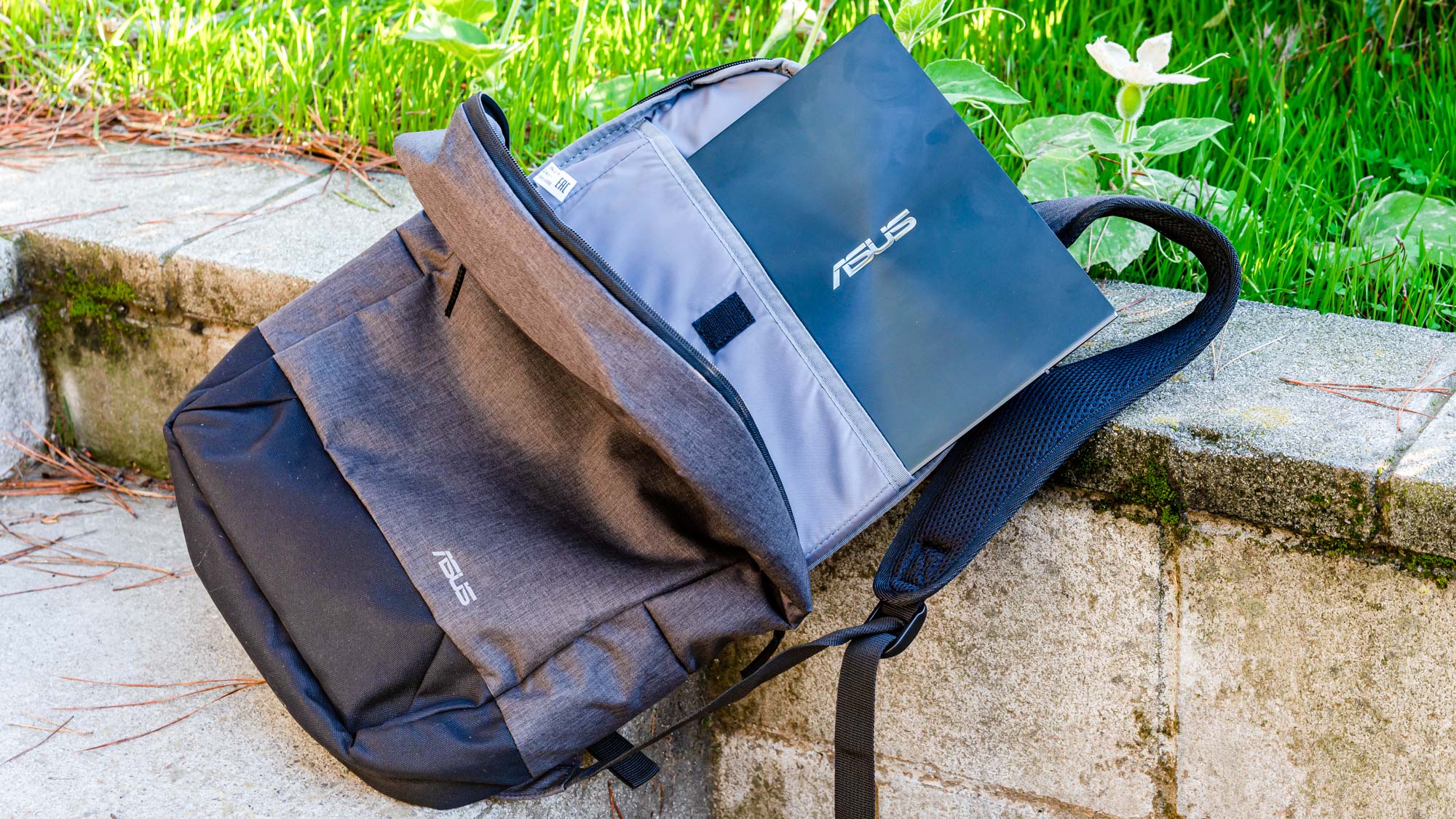
The model I reviewed, equipped with a Core i9-10980HK CPU, 32GB of RAM, an Nvidia GeForce RTX 3070 GPU, and a 1TB M.2 NVMe SSD, will gear up you back $2,999.99. Other variants dial down the CPU to a Core i7-10870H and offer either 16 or 32GB of RAM. All models are bundled with a stylus and and a palm rest, just only the variants with 32GB of RAM come bundled with an ergonomic stand and a haversack, if that sounds highly-seasoned to you.
Asus ZenBook Pro Duo xv OLED review: Design
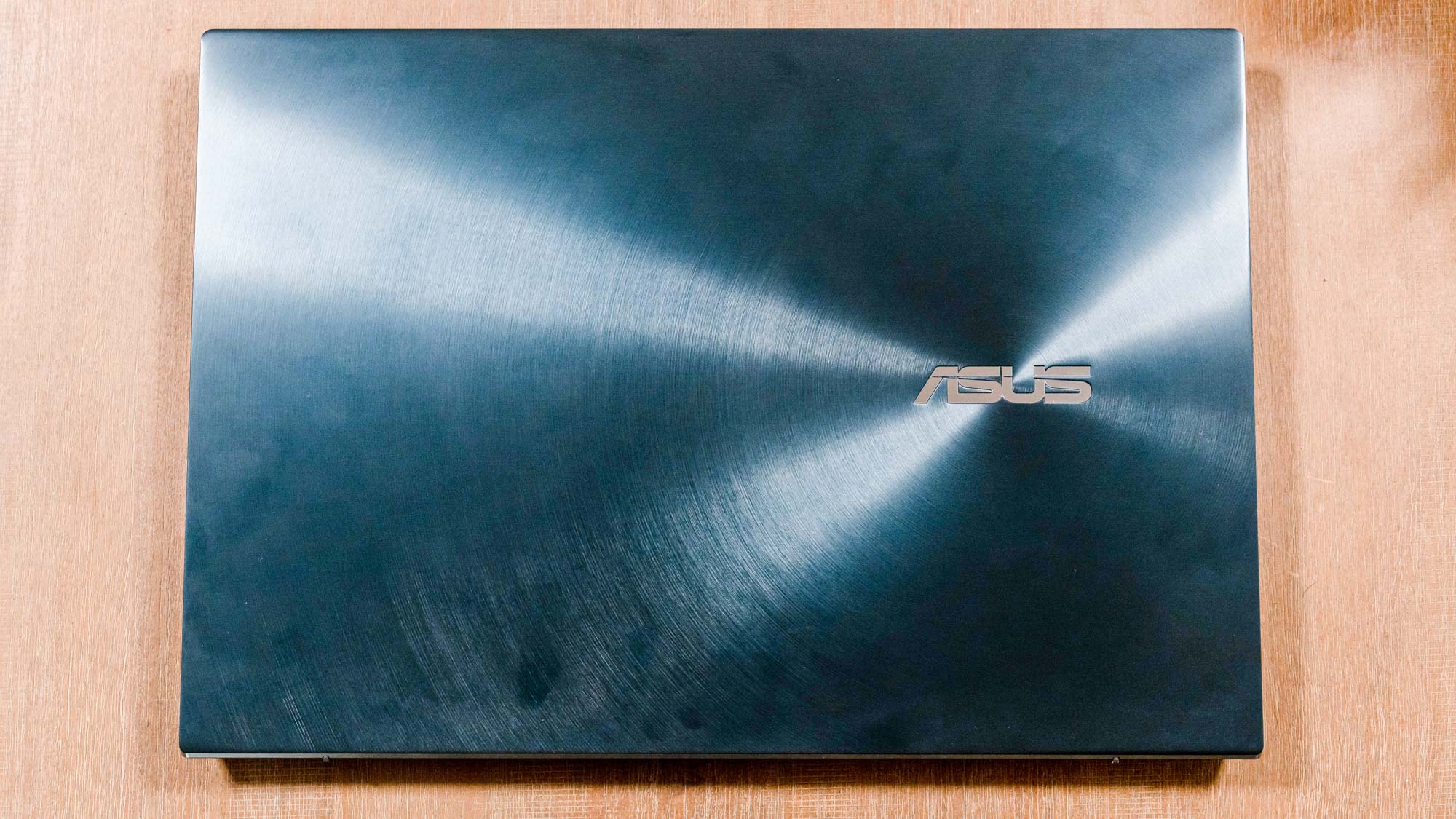
The ZenBook Pro Duo 15 OLED is striking, to say the least. It's big, but sleek, with an angular silhouette that hints at the powerful parts packed into its magnesium-alloy shell. When y'all lift the lid the second display — or, "ScreenPad Plus" — tilts upward, improving the viewing angle and exposing an additional pair of fans to aid air and heat broadcast through the chassis.
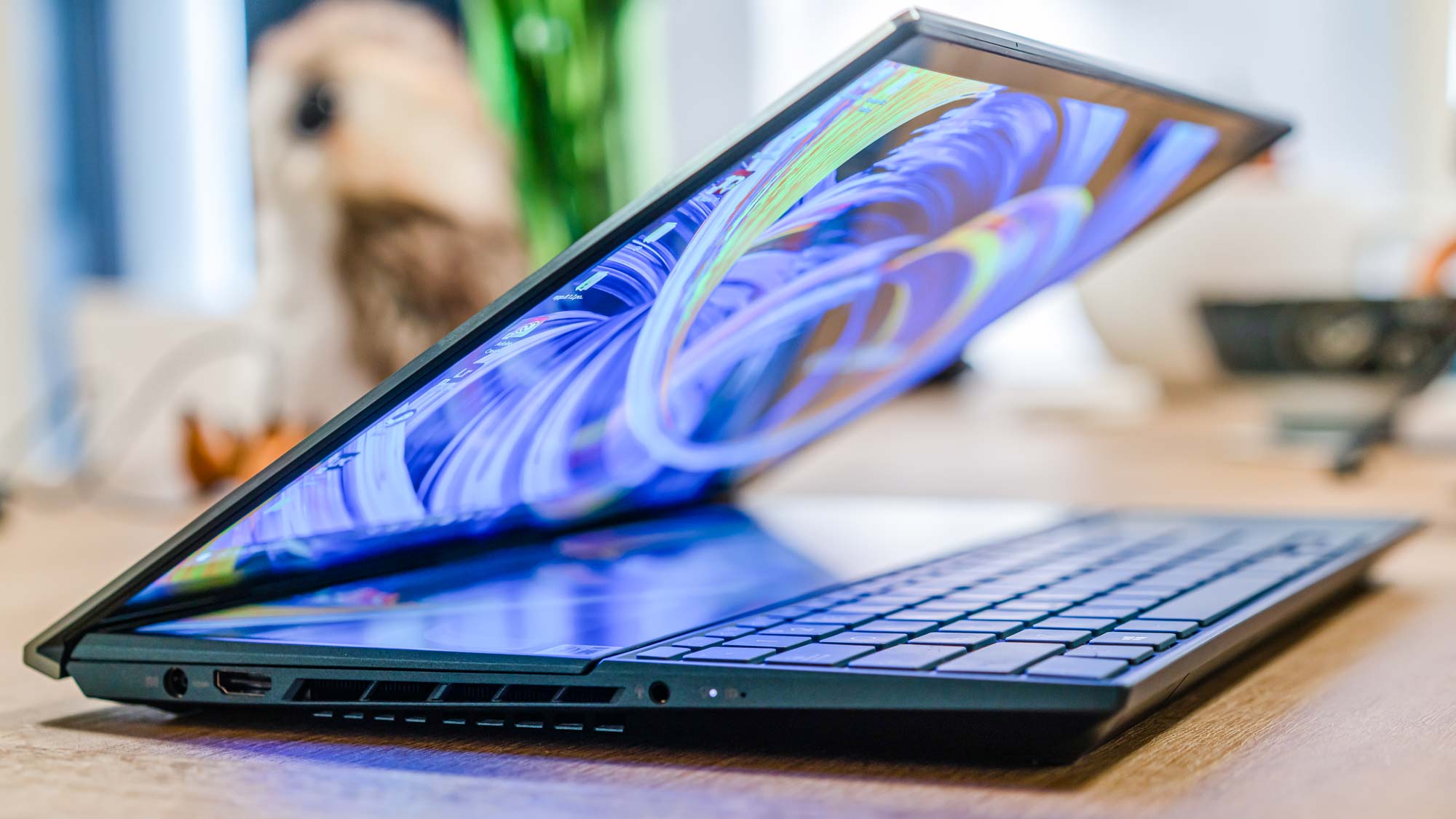
And the hinge is sturdy, remaining absolutely rigid as I press against it while scribbling on the displays with the bundled stylus. It's a singular design, and a clear evolution over its predecessor, the Asus ZenBook Pro Duo — albeit with many of the same drawbacks.
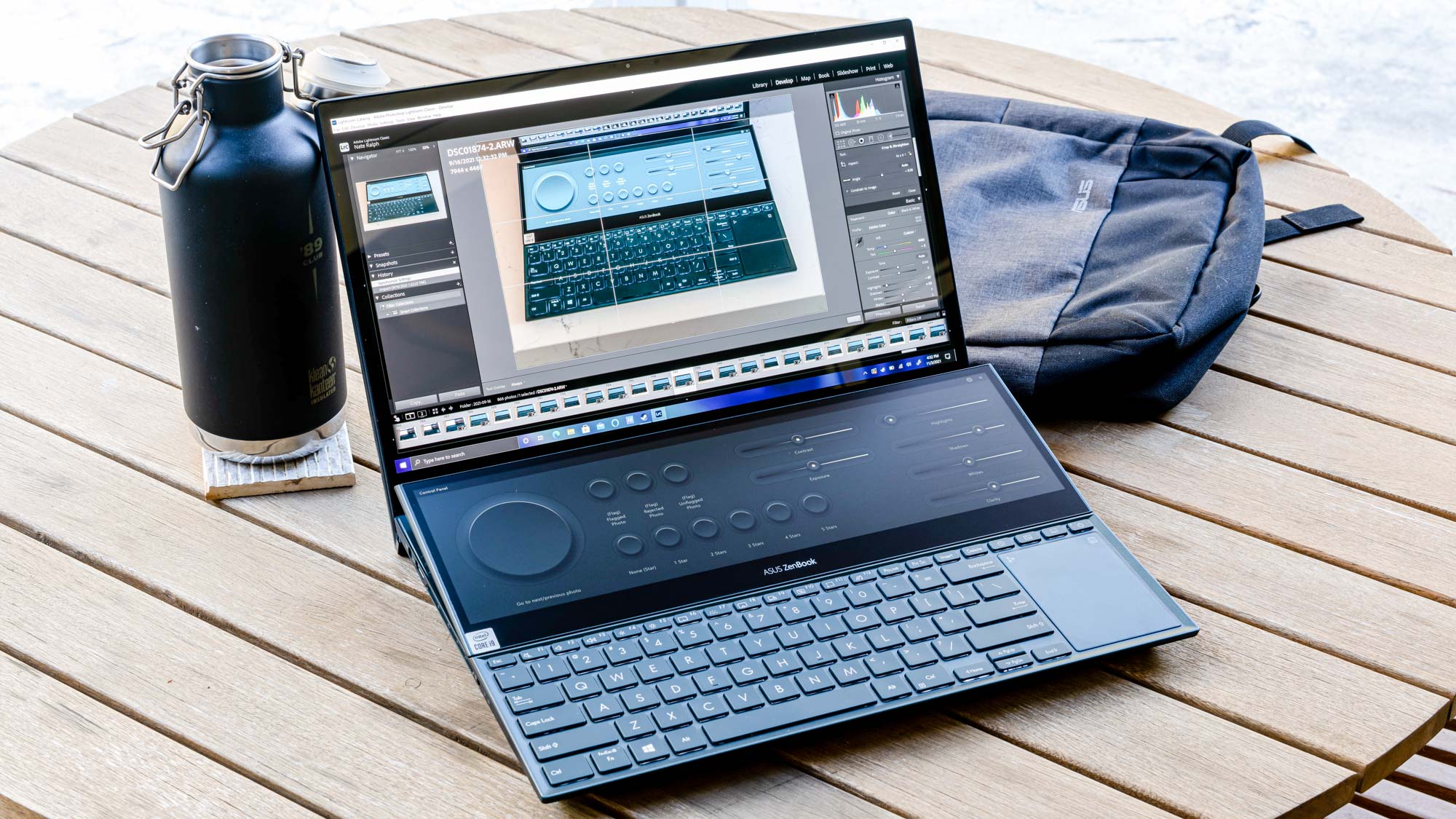
You lot're sacrificing a lot for the ScreenPad Plus' potential utility. To fit the display and maintain a reasonable footprint, they keyboard has been shunted down to the lower edge of the device, with the trackpad kicked out to the right side; as a lefty, this took a moment to wrap my head around.
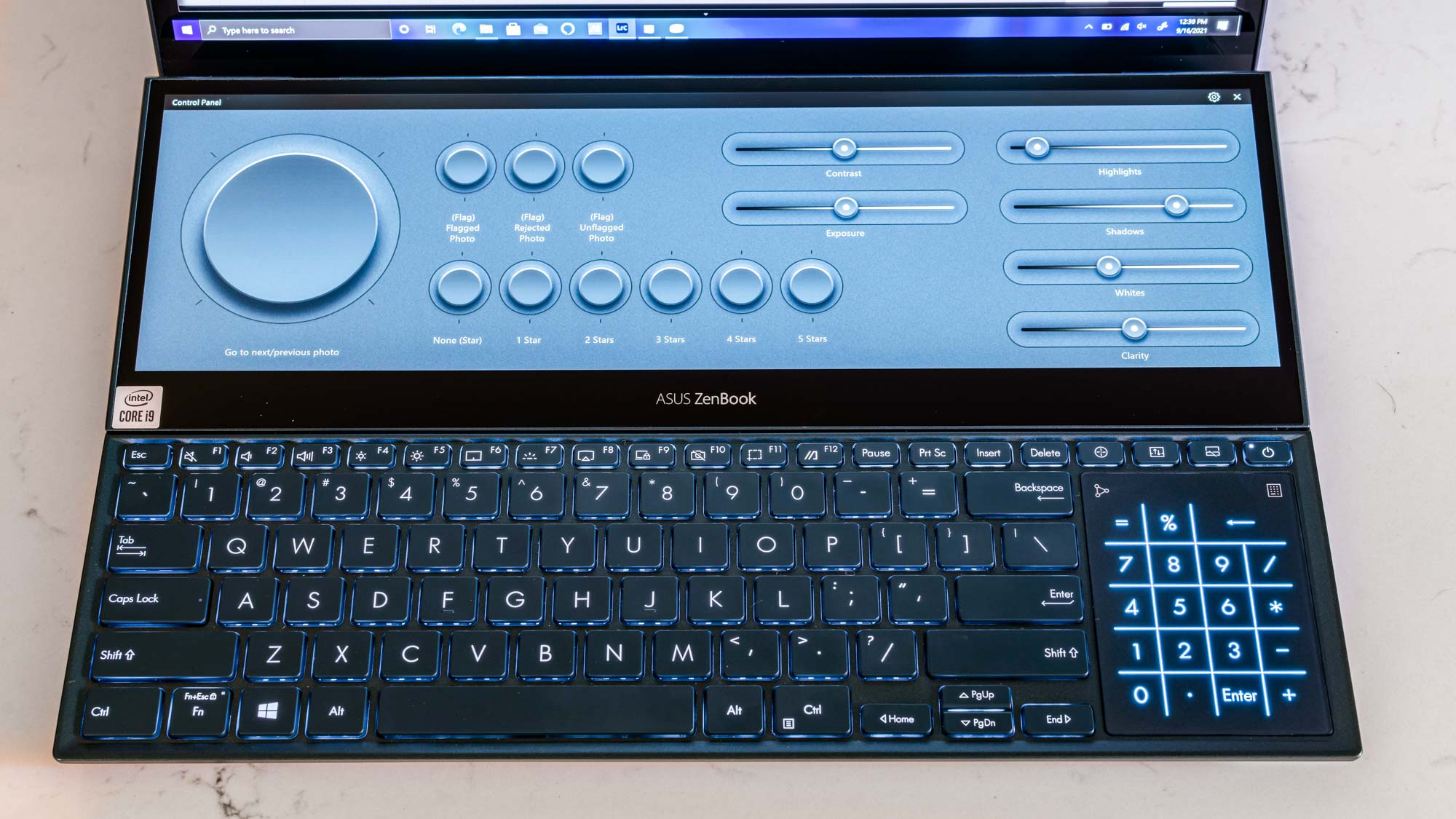
The layout is decidedly uncomfortable if you're the sort who uses a laptop in their lap, every bit your hands need to move farther down the trunk of the automobile to go whatever typing done. If y'all're willing to accept being deskbound, Asus has bundled a palm residuum and a folding stand to assist flesh out the ergonomic experience; these chip away at the inherent portability of a laptop, but given this machine's size (and battery life) that was never really in the cards.
Asus ZenBook Pro Duo 15 OLED review: Ports
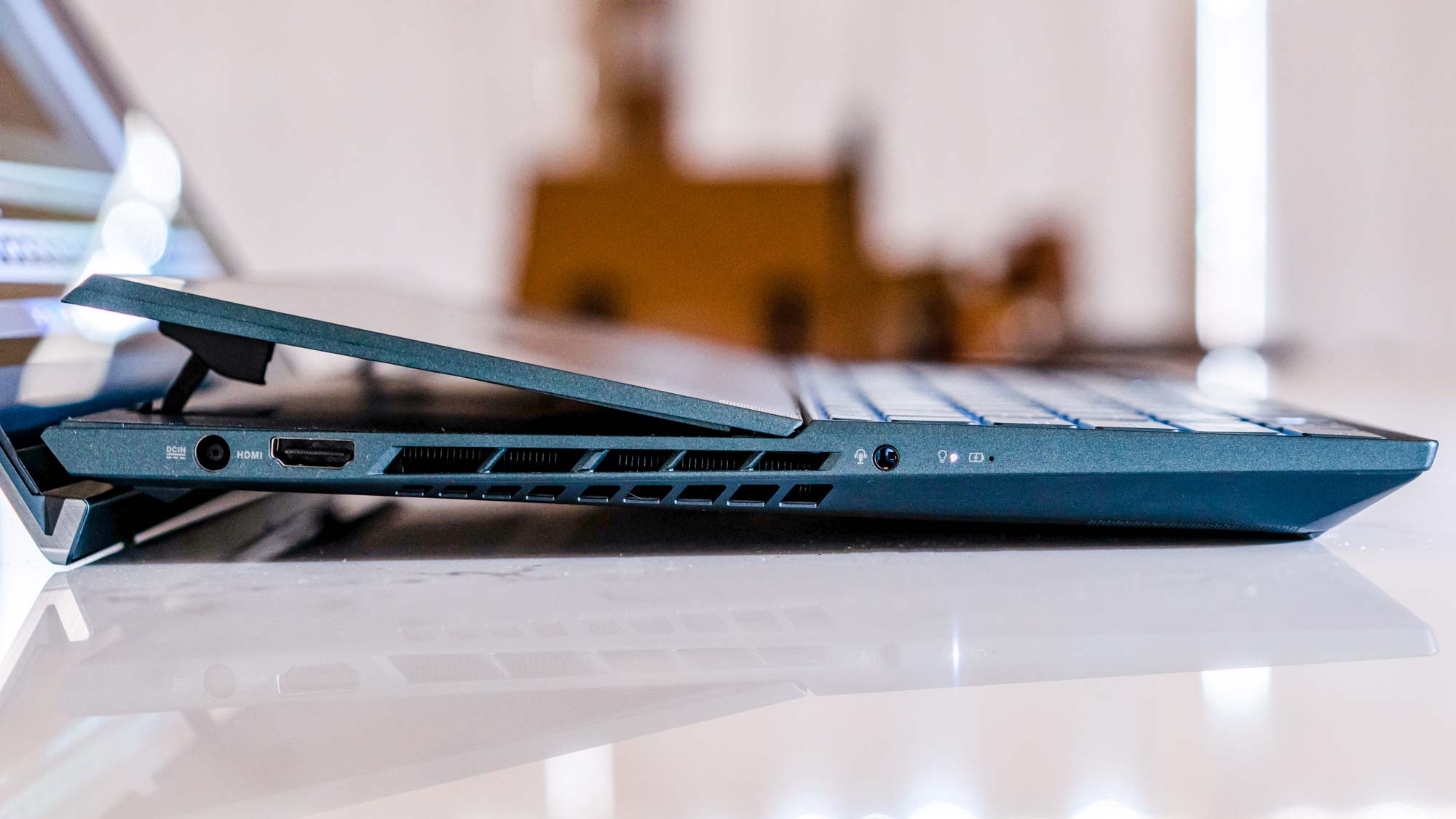
There are a pair of Thunderbolt three USB-C ports on the right side of the car, paired with a single USB 3.i Gen 2 port.
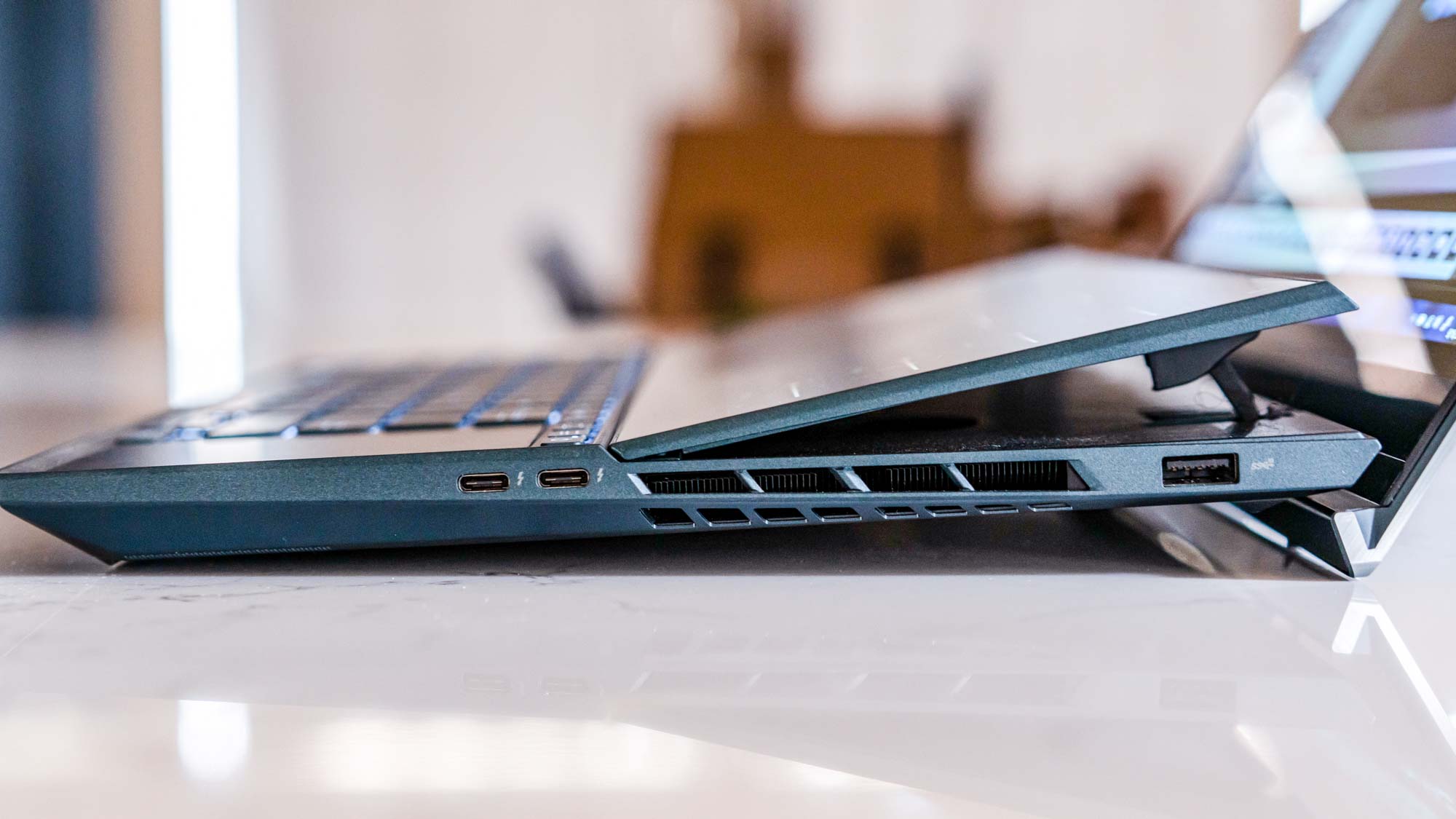
On the left, you'll find the DC-in jack, an HDMI 2.ane port, and the 3.5mm audio jack. The selection feels a bit lackluster on a machine this large, only much of the available space is ceded to ventilation, to go on things cool.
Asus ZenBook Pro Duo xv OLED review: Display
Let's showtime up top with the 15.6-inch, 3,840 x 2,160 pixel resolution OLED HDR display. Information technology delivers on all fronts, serving up deep blacks, vibrant colour (rated at 100% DCI-P3 color gamut, and Pantone validated), and observable effulgence that makes for a bully viewing experience, even at awkard angles or while working outside. I did a bit of gaming, but the bulk of my time was spent in Adobe Lightroom Classic, culling and editing photos, where the display does an excellent task of rendering truthful-to-life images.
The secondary display takes a bit more endeavor to wrap one'south head around. The ScreenPad Plus offers a iii,840 x 1,140 pixel resolution, simply it's an "IPS-level" brandish, and not an OLED, and the departure in quality is jarring given its proximity to a much nicer screen. Colors feel flatter and duller by comparision, which might be disappointing for someone hoping to use it for inking.
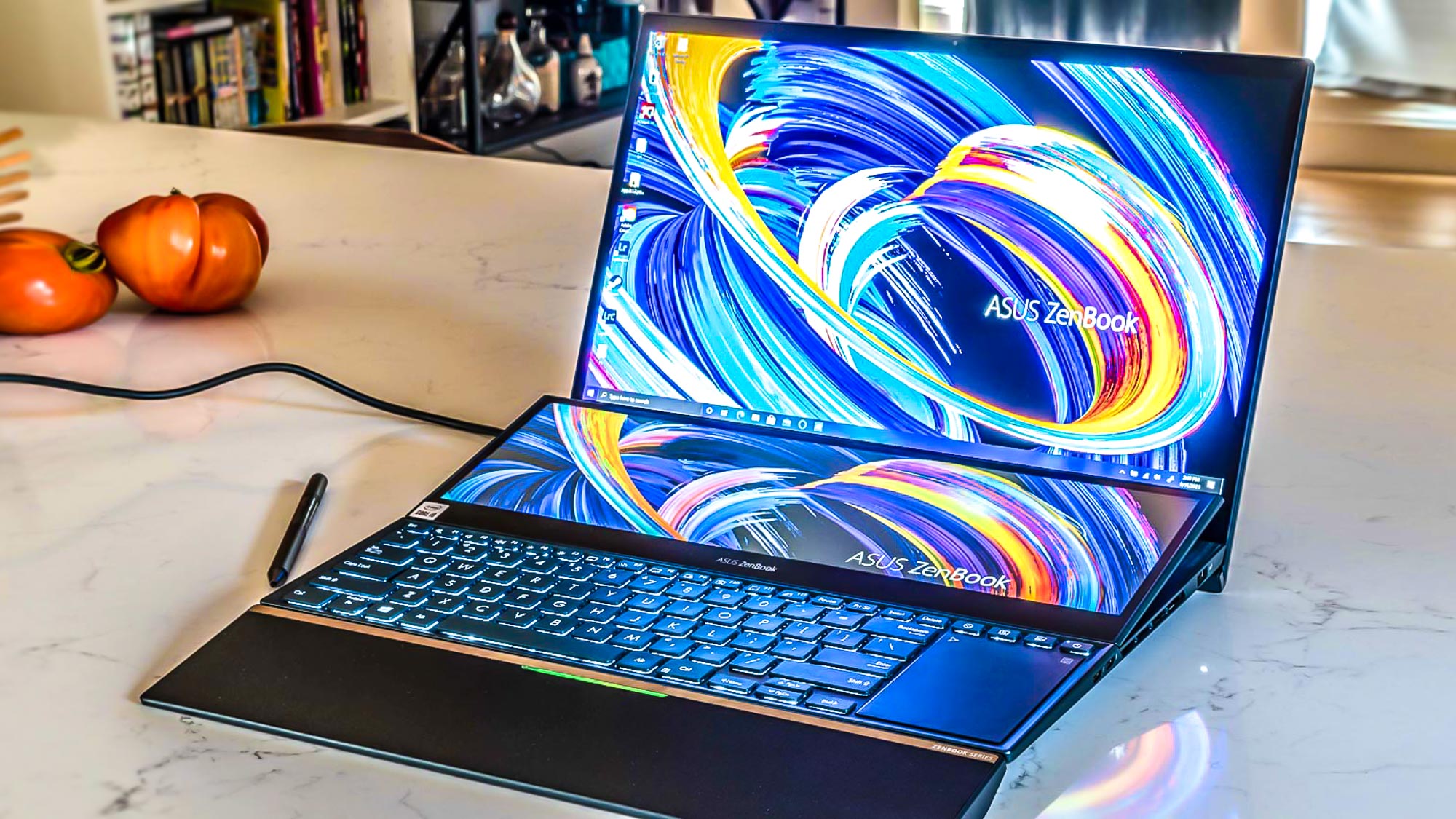
The ScreenPad Plus really shines if you use one of the limited list of apps supported by Asus' "Control Panel" software. I use two of them — Adobe'south Photoshop and Lightroom Classic — regularly, and having a dedicated choice of buttons and sliders at hand is a promising prospect, even if the execution leaves something to be desired. It's also handy as a general spot to park browser windows or documents, with clever UI touches like shortcuts for moving things from one display to another.
Asus ZenBook Pro Duo fifteen OLED review: Keyboard, Touchpad, and Stylus
On a tabular array or desk, the elevated bending makes for comfy typing, and makes the second brandish easy to read. The palm rest is yet some other thing to toss into my backpack, but it makes typing far more bearable. The keyboard is otherwise neat, with a spacious layout and keys that offer a off-white corporeality of travel with every press.
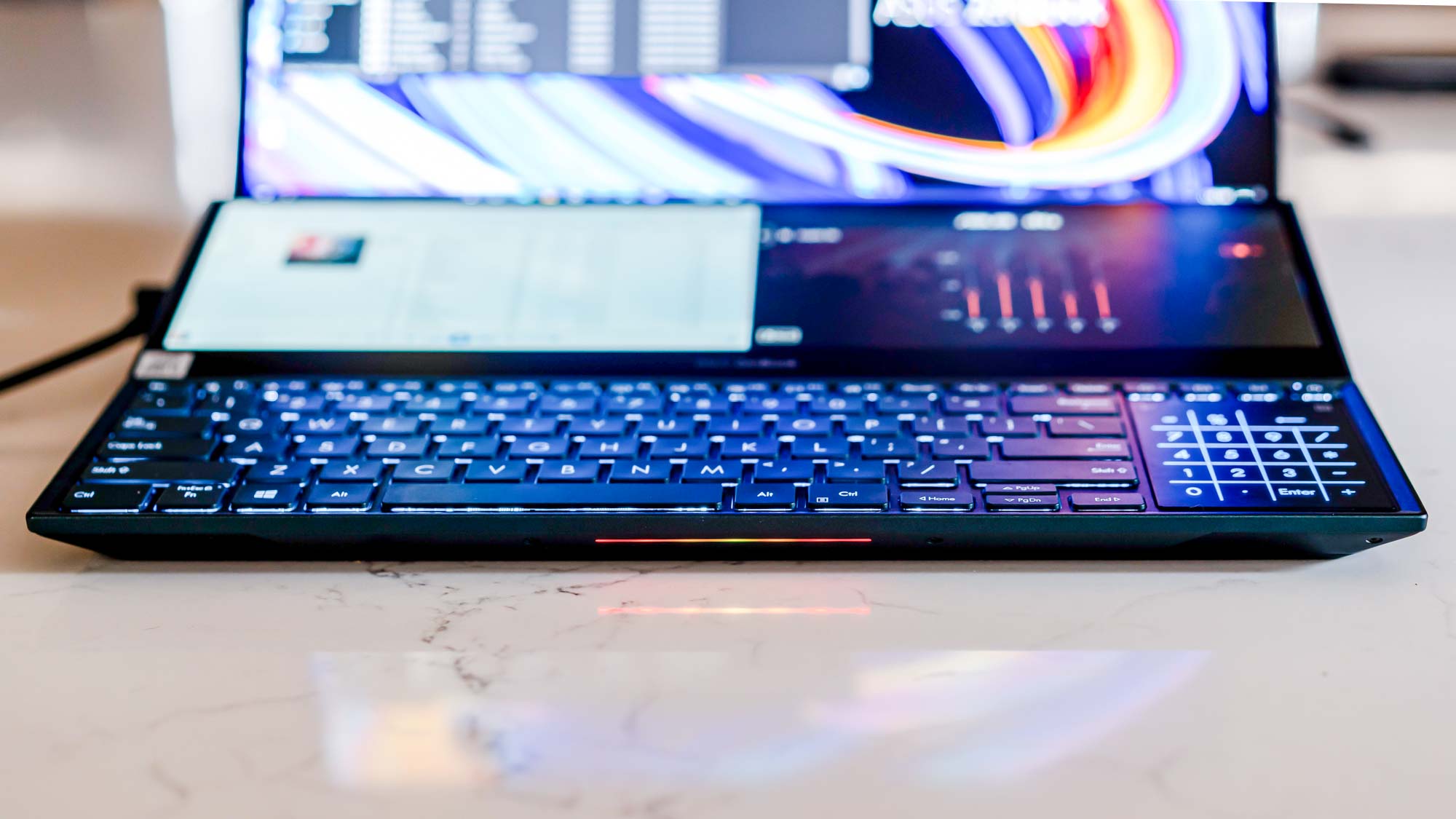
The trackpad is taller than information technology is broad, which makes some gestures in Windows ten a niggling tricky for my large hands. Y'all can besides plow the trackpad into a number pad by pressing a small computer symbol on the pinnacle right corner, a minor touch that's libation than it has any right to be. Given the general difficulty in using this machine without a full desk to prop it up onto, you lot'd do well to toss a mouse into your haversack besides. Asus besides included a stylus. There'southward no user-friendly place to put it when it's not in utilise, and unless you're especially cracking on drawing on either of the 2 displays, it doesn't offer whatsoever novel functionality.
Asus ZenBook Pro Duo 15 OLED review: Audio
The Harmon Kardon speakers sound a little apartment out of the box, and so I spent a few minutes with the equalizer in the DTS Audio Processing ap to get things balanced to my liking; at that place'south enough flexibility there to actually unlock what the speakers are capable of.
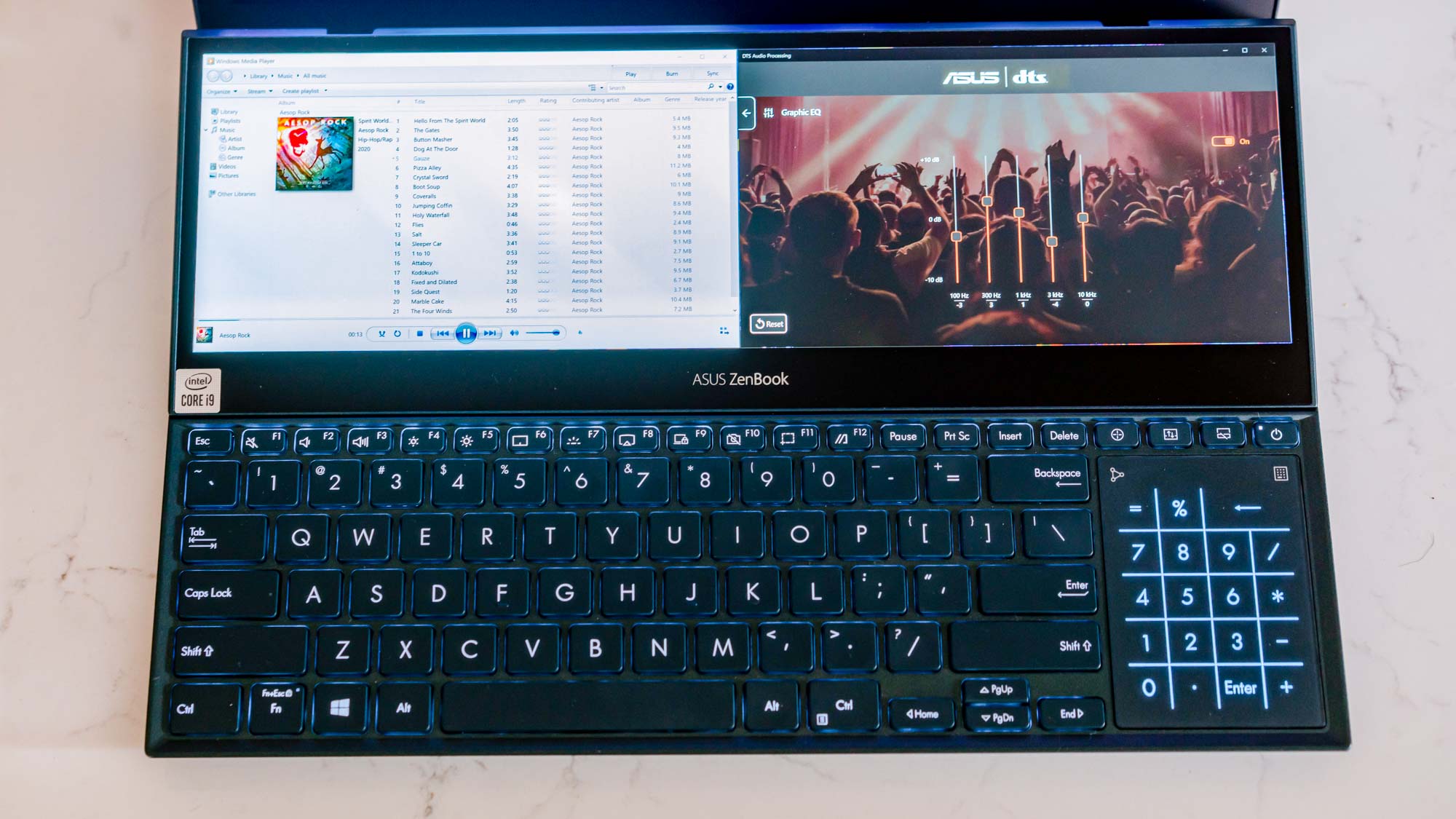
They're loud and reasonably well-rounded, easily filling a room with sound, though there'south some distortion if you crank the volume up as well far. And while I'grand no audiophile, I found it strangely attracting to make subtle adjustements to the EQ on the secondary display while writing up top; your mileage may vary.
Asus ZenBook Pro Duo 15 OLED review: Performance
The Asus ZenBook Pro Duo fifteen OLED earned a score of 7,028 on the Geekbench 5.iv multicore benchmark. It cruises past many of the other machines on our lists, like Microsoft's AMD-powered Surface Laptop 4 (half-dozen,748), and the Razer Blade xv Advanced (vi,662), just lags behind Dell's XPS xv OLED (seven,477).
The machine completed our Handbrake video encoding test in 8 minutes and 18 seconds, once over again edged out by Dell'due south XPS 15 OLED (8:10). Its 1TB NVMe SSD hit a transfer rate of 950.1 MBps, outpacing the contest: the Dell XPS xv OLED earned a transfer rate of 825.6 MBps, and the Razer Blade 15 Advanced a rate of 890MBps.
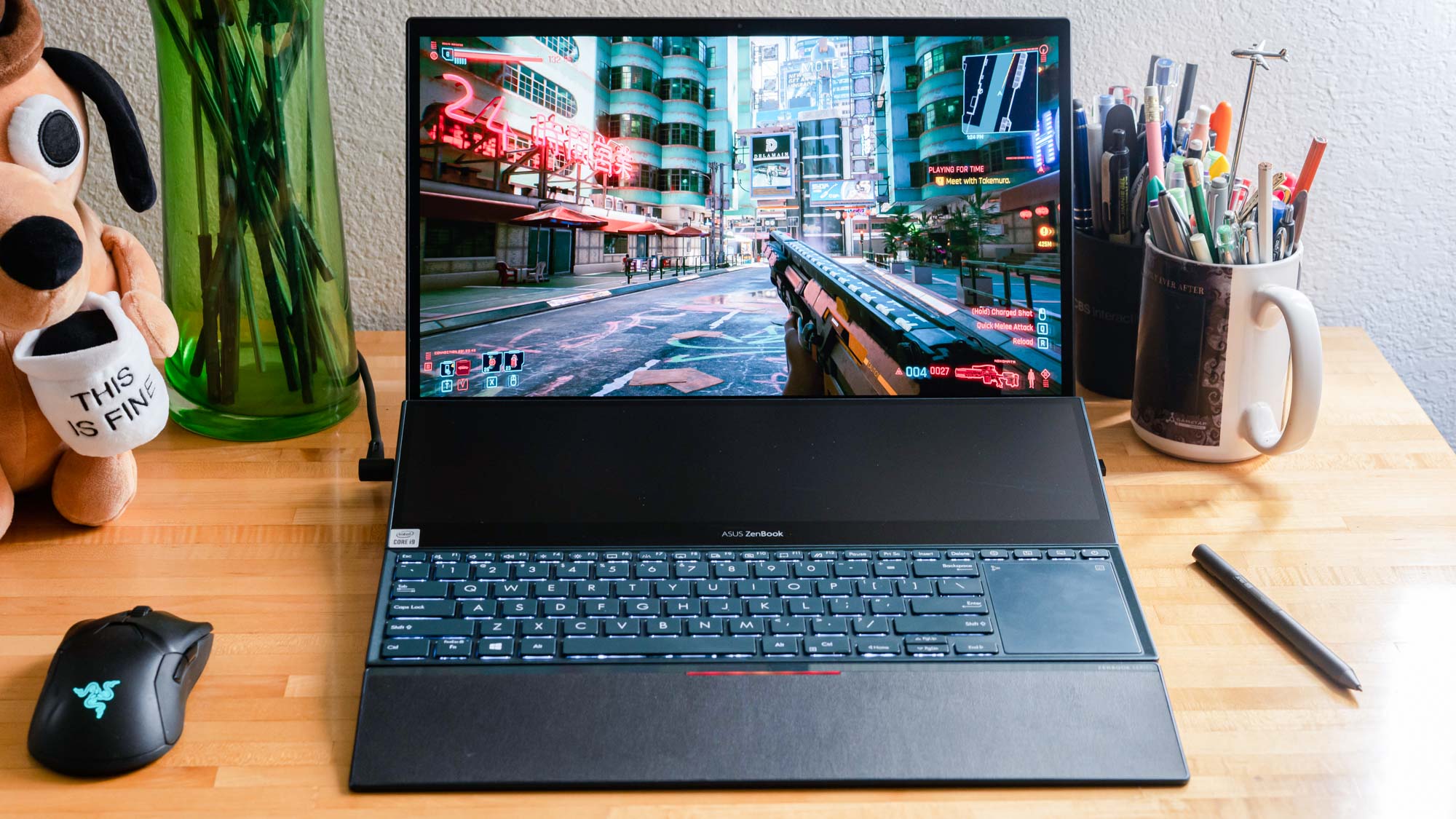
The ZenBook Pro Duo met or exceeded the 60 frames per 2d sweet spot at 1080p resolutions on just about everything we tested, including Assassin's Creed Valhalla (62 fps), Borderlands 3 (67 fps), and Shadow of the Tomb Raider (71). It's bested by machines built with gaming in mind, similar the Razer Blade 15 Advanced, which is powered by an Nvidia Geforce RTX 3080. The ZenBook Pro Duo failed to striking 30 frames per 2d when nosotros cranked the settings upwards to 4K on only about all of our gaming benchmarks, eking out a mere 36 fps in Dirt 5.
Anecdotally, Cyberpunk 2077 hovered at 26 to thirty frames per second on the Ultra preset, with Ray Tracing dialed up at the 4K resolution, only judicious tweaking of the settings brought me closer to a frame rate I'd really be willing to play at. No Man'southward Sky fared ameliorate, hovering around 35 to 40 frames per second at maximum settings. In both cases the car's fans roared to keep temperatures in check, so you lot'll want to wearable headphones or creepo the speakers upwardly if you're keen on gaming undisturbed.
Asus ZenBook Pro Duo fifteen OLED review: Battery Life
The ZenBook Pro Duo xv OLED gave up the ghost after 5 hours and one infinitesimal on our Web Surfing bombardment test when both displays were on. Shutting off the secondary display nets a bit more time, at six hours and 50 minutes. On the PCMark x gaming criterion, information technology eked out i hour and 46 minutes of life with both displays on, and lasted for 1 hour and 54 minutes when the second brandish was turned off.
These numbers are wholly unsurprising, given the hardware at piece of work here. In my own anecdotal testing I generally saw about iv to five hours before I had to reach for the power adapter, just given the inherent difficulty in using this machine without a dedicated surface to balance it on, it wasn't all that problematic.
Asus ZenBook Pro Duo xv OLED review: Webcam
The 720p infrared camera is uniform with Windows Hello for an effortless login experience, which is the best that can be said about it. Dull, desaturated colors and grainy video make for and underwhelming video conferencing feel. Teleconferencing doesn't seem to be a focus point for this car so this isn't surprising, simply it's ever a piddling disappointing at this pricepoint.
Asus ZenBook Pro Duo fifteen OLED review: Rut
The temperatures starting time to climb when the automobile is nether duress, primarily flowing out of the bottom and sides of the chassis equally the ventilation system works to keep the innards in check. We recorded the hottest temperatures underneath the motorcar, where it peaked at 139.5 degrees Farenheit.
It can get uncomfortable while the machine is perched on my legs, but it's too cumbersome to ever spend much time in my lap, and heavy workloads sap the battery, which brought me back to a desk and charger anyway; it'southward a cocky-correcting problem.
Asus ZenBook Pro Duo fifteen OLED review: Software
In that location isn't much in the manner of pre-installed software: the MyAsus hub keeps track of arrangement updates and some display settings, including the ability to choose distinct color profiles, or manually set the white balance. Of item interest is Control Console, which turns the ScreenPad plus into a dedicated brandish that offers customizable shortcuts for a select grouping of apps; fortunately for me, Adobe's Lightroom Classic and Photoshop are on the list.
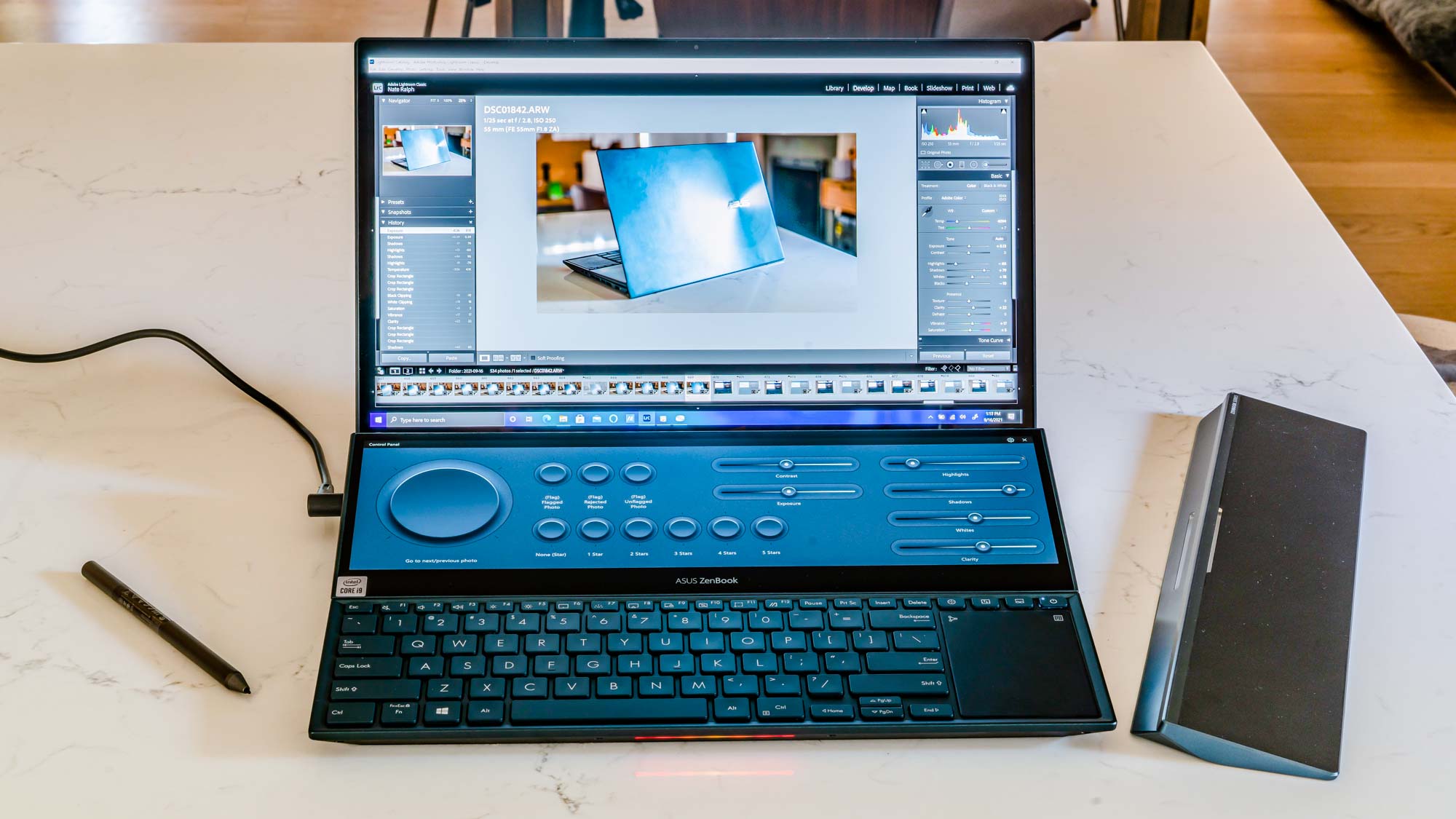
Control Panel is a neat concept, but there are also some idiosyncracies to work out. I tested Control Center primarily in Lightroom, using the sliders to tweak the images I'd shot. It's responsive, suitable for wide strokes or fine adjustments, simply the tool doesn't actually receive whatever data from Lightroom: if I made adjustments direct in the app, or switched to a unlike image, the secondary display still reflected whatever adjustments I terminal made. This is fine if I'thou spending a lot of time on a single prototype, only gets frustrating when making subtle tweaks to a batch of images (for, say, a laptop review), and the adjustment I made on one prototype is of a sudden carried over to a wildly different paradigm, because the slider was no longer in a neutral position.
I ultimately swapped out the controls to inconsequential actions like flagging or rating images, but the keyboard shortcuts for those are ingrained in my memory, and I ended up rarely using the ScreenPad Plus at all, obviating the need for a second display in the first place. With an update to enable better communication betwixt apps, I could see some existent workflow benefits to having a dedicated console for shortcuts correct at might fingertips, without needing external hardware.
Asus ZenBook Pro Duo xv OLED review: Verdict
I adore the novelty on display here. With a few software updates in the right direction, the ScreenPad Plus could make a novel complement to content creation workflows, while time to come iterations of the hardware could help bridge the performance gap. Only fifty-fifty then, the ScreenPad Plus' potential utility doesn't overcome the ergonomic concessions required to make it fit, resulting in a deskbound laptop that delivers a lesser user experience to hooking a second monitor up to your run of the mill machine.
Without some killer app or functionality, the 2nd display is more than hindrance than help. Your funds would be improve spent on something more traditional, similar Dell's XPS 15 OLED, and using the money you salve on a full-sized screen.

Source: https://www.tomsguide.com/reviews/asus-zenbook-pro-duo-15-oled
Posted by: vogelsangapprokill.blogspot.com
0 Response to "Asus ZenBook Pro Duo 15 OLED review"
Post a Comment